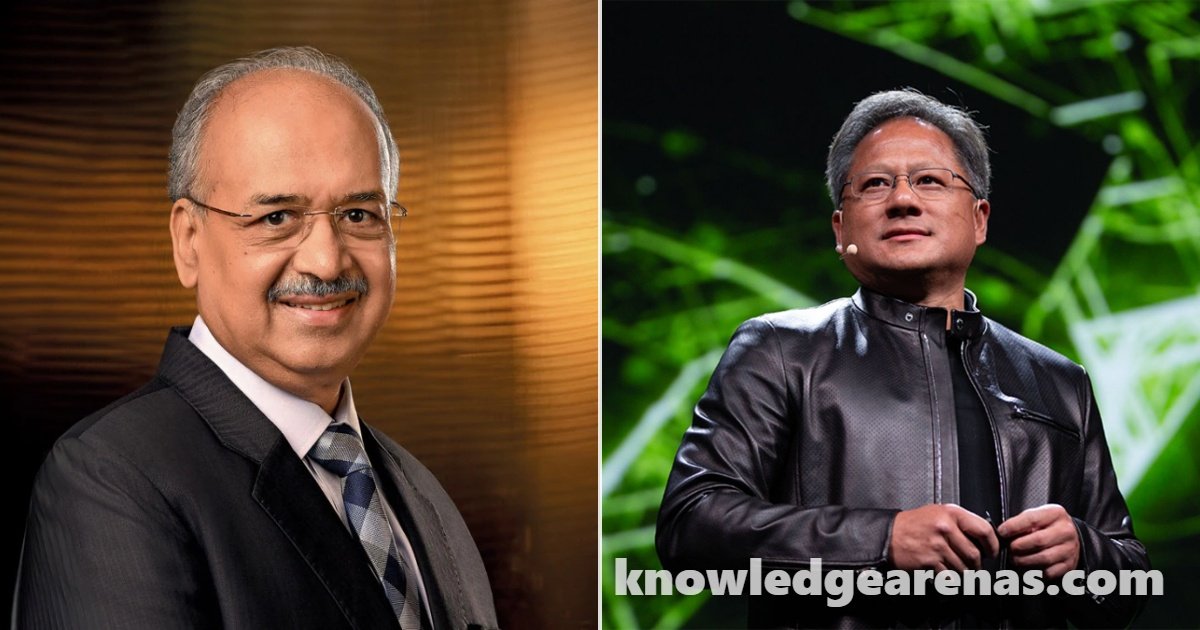
Who Are Dilip Shanghvi and Jensen Huang?
Dilip Shanghvi is the founder of Sun Pharmaceutical Industries and one of India’s best-known pharmaceutical entrepreneurs. He started Sun Pharma in 1983 after borrowing $200 from his father, initially focusing on psychiatric medicines. Over the following decades, he expanded the company through organic growth and acquisitions, helping it become a major international pharmaceutical business. Forbes reported his real-time net worth at about $27.2 billion on September 1, 2026.
Jensen Huang is the founder and CEO of NVIDIA, the semiconductor and computing company he co-founded in 1993. NVIDIA’s development of the GPU and its later expansion into accelerated computing helped create the technological foundation for modern artificial intelligence. NVIDIA says Huang has led the company as president and CEO since its beginning and holds engineering degrees from Oregon State University and Stanford University.
When comparing dilip shanghvi and jensen huang, the first major difference is their professional background. Shanghvi developed his career around healthcare, medicine, business strategy, and international pharmaceuticals. Huang came from an engineering and semiconductor background and built his career around computing technology.
Dilip Shanghvi’s Rise in Pharmaceuticals
The story of dilip shanghvi and jensen huang begins very differently. Shanghvi did not inherit a giant pharmaceutical corporation. He began with a small business and gradually developed Sun Pharma into a global company.
His strategy included entering specialized pharmaceutical markets, expanding internationally, and making carefully selected acquisitions. One of the most important transactions was Sun Pharma’s $4 billion acquisition of Ranbaxy Laboratories in 2014. Forbes identifies the Ranbaxy transaction as the largest acquisition in Shanghvi’s business-building journey.
The example of dilip shanghvi and jensen huang shows how founders can create enormous companies without following the same formula. Shanghvi relied heavily on business discipline, market expansion, acquisitions, and pharmaceutical expertise rather than technology-sector disruption.
Jensen Huang and the Rise of NVIDIA
The other half of the dilip shanghvi and jensen huang comparison is Jensen Huang’s extraordinary technology journey.
Huang co-founded NVIDIA in 1993, at a time when computer graphics were becoming increasingly important. NVIDIA’s invention of the GPU in 1999 changed computer graphics and helped establish a platform that eventually became critical to high-performance computing and artificial intelligence.
The importance of dilip shanghvi and jensen huang as a comparison becomes clearer when looking at how both founders recognized opportunities before their industries reached today’s scale. Shanghvi saw opportunities in pharmaceuticals and international healthcare markets, while Huang recognized the long-term potential of programmable graphics processors and accelerated computing.
NVIDIA’s position in the AI industry has dramatically increased Huang’s global influence. Recent reporting has described him as one of the central figures in the worldwide AI boom, while NVIDIA’s own biography highlights the company’s role in accelerated computing and generative AI.
Business Strategies Compared
There is no established evidence that dilip shanghvi and jensen huang are business partners or that they run a joint venture. Their connection is primarily interesting as a comparison between two highly successful entrepreneurs from different industries.
Dilip Shanghvi’s approach has centered on pharmaceuticals, acquisitions, product portfolios, international markets, and disciplined capital allocation. In 2026, Shanghvi said Sun Pharma would maintain a disciplined approach to mergers and acquisitions, with interest in innovative medicines globally and smaller opportunities in emerging markets.
Jensen Huang’s strategy has been much more technology-driven. NVIDIA has developed hardware and software ecosystems around accelerated computing, allowing the company to benefit from growing demand for AI infrastructure. The company says its GPU innovation eventually helped ignite the era of modern AI.
That difference makes dilip shanghvi and jensen huang a useful business case study. One leader built a global healthcare empire through pharmaceuticals and strategic expansion; the other built a technology platform that became central to the AI economy.
Wealth and Global Influence
The fortunes associated with dilip shanghvi and jensen huang reflect the enormous scale of their companies, although their wealth changes with markets and should not be treated as a permanent figure.
Forbes listed Shanghvi at approximately $27.2 billion as of September 1, 2026. Huang’s wealth has also risen dramatically alongside NVIDIA’s valuation and the explosive demand for AI computing. Recent reporting placed his personal fortune above $100 billion.
The contrast between dilip shanghvi and jensen huang also demonstrates how wealth can be created in very different sectors. Healthcare depends on medicines, research, manufacturing, regulation, and distribution, while modern AI infrastructure depends on semiconductors, software, data centers, and computing demand.
What Can Entrepreneurs Learn From Them?
The most valuable lesson from dilip shanghvi and jensen huang is that successful entrepreneurship usually requires patience.
Shanghvi spent decades expanding Sun Pharma rather than trying to create an overnight success. His company grew through acquisitions and expansion into global markets. Huang similarly stayed with NVIDIA through major changes in computing, including the transition from graphics technology toward accelerated computing and AI.
Another lesson from dilip shanghvi and jensen huang is the importance of understanding an industry’s future before the opportunity becomes obvious. Their careers show that founders can build enormous businesses by developing expertise, taking calculated risks, and remaining committed to long-term technological or market changes.
Are Dilip Shanghvi and Jensen Huang Connected?
There is no strong publicly documented evidence establishing a major business partnership, joint company, or direct commercial relationship between dilip shanghvi and jensen huang. Their names are generally discussed together because both are prominent billionaire founders and influential business leaders.
The comparison between dilip shanghvi and jensen huang is therefore more useful as a study of entrepreneurial leadership than as a story about a shared business venture.
Conclusion
Dilip Shanghvi and Jensen Huang built their fortunes in completely different worlds, yet their careers contain several common themes: persistence, strategic thinking, industry knowledge, calculated risk-taking, and a willingness to invest in long-term opportunities.
Dilip Shanghvi turned a modest pharmaceutical venture into a global healthcare company, while Jensen Huang helped turn NVIDIA into a defining force in accelerated computing and artificial intelligence. Looking at dilip shanghvi and jensen huang together shows that there is no single path to entrepreneurial success. Their stories demonstrate how different industries can produce equally powerful examples of vision, discipline, and long-term leadership.
FAQs
1. Who is Dilip Shanghvi?Dilip Shanghvi is the founder and executive chairman of Sun Pharmaceutical Industries and a major figure in India’s pharmaceutical industry.
2. Who is Jensen Huang?Jensen Huang is the co-founder, president, and CEO of NVIDIA, a leading company in GPUs, accelerated computing, and artificial intelligence.
3. Are Dilip Shanghvi and Jensen Huang business partners?There is no well-established public evidence that the two entrepreneurs are business partners or operate a joint venture.
4. What industries do Dilip Shanghvi and Jensen Huang represent?Shanghvi represents pharmaceuticals and healthcare, while Huang represents semiconductors, computing, and artificial intelligence.
5. Why are Dilip Shanghvi and Jensen Huang compared?They are compared because both built globally influential companies and became prominent billionaire entrepreneurs, despite working in very different industries.
About the Author